
Holistic Health and Vitality with Ebru Şinik
Ayurveda is an ancient body of wisdom that views each person not only through the physical body, but also through the mind, emotions, daily habits and relationship with nature.
In this guide, you can explore the foundations of Ayurveda, the concept of Prakruti, the Vata, Pitta and Kapha doshas, and practical ways to bring Ayurvedic living into everyday life through Ebru Şinik’s holistic wellbeing perspective.

Your genes are not your destiny. Lifestyle choices can influence how genes function and are expressed.
What Is Ayurveda?
In Sanskrit, “Ayur” means life and “Veda” means knowledge or wisdom. Ayurveda is therefore often described as the “Science of Life.”
In Ebru Şinik’s approach, Ayurveda is not a system used only when certain symptoms appear. It is a guide that can help people live with greater awareness, balance and harmony. Daily routines, nutrition, sleep, seasonal transitions, mental intensity, breath, movement and inner balance are all important parts of this perspective.
Ayurveda does not offer exactly the same recommendation to everyone. Its central question is: “What is balancing for my nature and my needs at this moment?” Ayurveda is therefore personal, observation-based and responsive to the changing nature of life.
The Core Focus of Ayurveda
- Understanding your individual nature and tendencies
- Bringing greater awareness to everyday habits
- Adapting to seasonal and life-stage changes
- Creating holistic harmony between body, mind and daily rhythm
Three Core Dimensions of Holistic Harmony
Holistic vitality is about more than feeling physically well. In Ebru Şinik’s wellbeing approach, each person is considered through physical, mental and inner dimensions.
Physical Body
This includes the tangible aspects of life such as nutrition, digestion, sleep, movement, resilience and daily energy levels.
Mental Body
Thoughts, belief patterns, emotional responses, the way we cope with stress and mental clarity all belong to this dimension.
Inner / Spiritual Dimension
Inner peace, a sense of meaning, connection with life and contact with one’s own essence are important parts of holistic balance.
Looking physically well may not be enough on its own. According to Ayurveda, genuine balance becomes stronger when a more harmonious relationship is created between the body, mind and inner life.
Your Unique Nature: Prakruti and the Doshas
According to Ayurvedic tradition, every person carries Vata, Pitta and Kapha, although the distribution and prominence of these three qualities can vary from one individual to another.
What Is Prakruti?
In Ayurveda, Prakruti refers to a person’s innate dosha constitution. It is considered as individual as a fingerprint and serves as an important reference point for understanding personal balance throughout life.
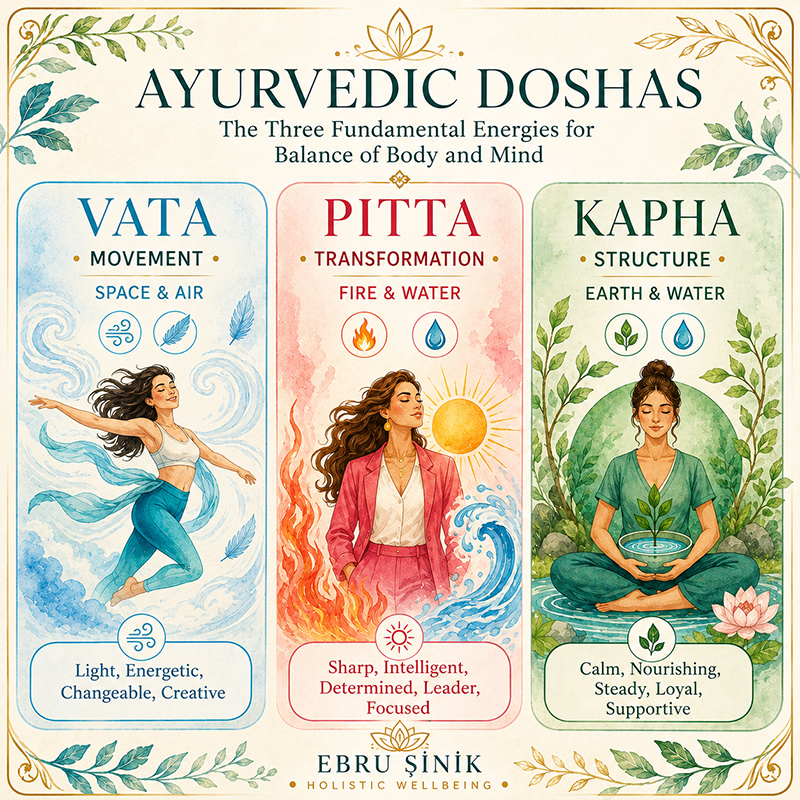
Different combinations of the five fundamental elements — space, air, fire, water and earth — form the three primary life principles known as the doshas: Vata, Pitta and Kapha.
Doshas are not intended to place people into rigid categories. They provide a framework for observing which qualities may be increasing, where support may be needed and how lifestyle habits might be adjusted.
Discover Your Dosha Tendencies
Take the Yükselen Çağ Dosha Test to explore whether Vata, Pitta or Kapha qualities may be more prominent in your constitution.
Vata Dosha
Space & Air · Principle of Movement
Vata is associated with movement, change, creativity, communication and flexibility.
When in balance:
- Creative and lively
- Quick to perceive and understand
- Joyful and active
When out of balance:
- A tendency toward restlessness and worry
- Irregular sleep patterns
- Feelings of dryness and scattered energy
Pitta Dosha
Fire & Water · Principle of Transformation
Pitta is associated with digestion, focus, analysis, determination and transformation.
When in balance:
- Intelligent and determined
- May show natural leadership qualities
- Focused on goals
When out of balance:
- Impatience and becoming tense easily
- An overly critical attitude
- Intense competitiveness and pressure
Kapha Dosha
Earth & Water · Structure and Stability
Kapha is associated with resilience, calmness, loyalty, structure, protection and stability.
When in balance:
- Calm and peaceful
- Loyal and compassionate
- Resilient and steady
When out of balance:
- A sense of heaviness and stagnation
- A tendency to postpone or avoid action
- Resistance to change
Note: Some people may display the qualities of two doshas more prominently. In rarer cases, traits of all three doshas may appear in a relatively balanced way. In these situations, it is important to choose balancing routines according to the season, stage of life and current daily needs.
Well-Aging and Ayurvedic Lifestyle Guidance
The aim of Ayurveda is not to create a perfect life, but to develop sustainable, balancing and conscious habits that respect each person’s individual nature.
Ayurvedic Nutrition and the Six Tastes
Ayurveda looks beyond calorie counting and also considers the nature of foods, their taste, the season and how different foods are combined. It is valuable to include natural, colourful and balanced choices in each meal whenever possible.
In Ebru Şinik’s approach, nutrition is viewed as a practice that supports the body, avoids overburdening digestion and remains aligned with the rhythm of daily life.
Digestive Strength and Agni
In Ayurvedic tradition, digestion is considered an important indicator of overall balance. The concept of Agni symbolically refers not only to physical digestion, but also to our capacity to process life experiences.
Regular meals, choices that do not overwhelm the body, suitable spices and a calm approach to eating are among the foundations that can support digestive wellbeing.
Restorative Sleep and Evening Rhythm
Regular, sufficient sleep is essential for physical recovery, mental clarity and daily balance. In Ayurveda, beginning to slow down before the night becomes too late is considered more compatible with the body’s natural rhythm.
Evening routines, conscious breathing and reducing digital stimulation may be especially supportive during periods of increased mental intensity.
Meditation and Ancient Breathing Practices
A stressful pace of life can keep the body in a state of constant alert. Conscious practices such as meditation and pranayama can support mental calm, breath awareness and inner balance.
In Ebru Şinik’s work, the breath is approached not only as a physiological function, but also as a powerful tool for supporting emotional and mental balance.
Spinal Health and Movement
Moving regularly without placing excessive stress on the body can support both physical resilience and mental wellbeing. Walking, yoga, stretching and body-awareness practices can all hold an important place in daily life.
The reminder that “we are as healthy and youthful as our spine” highlights the important role of movement in holistic wellbeing.
Seasonal and Circadian Routines
Ayurveda understands life as cyclical rather than fixed. The time of day, seasonal transitions and different stages of life can influence individual needs.
For this reason, routines that feel supportive may need to be reassessed from time to time. Nutrition, sleep and movement aligned with the seasons are fundamental parts of Ayurvedic living.
Moving Toward Balance Through the Senses
In Ayurveda, the five senses are viewed as important gateways that can influence quality of life, perception and inner balance.
Aromatherapy and Scent
Natural aromas selected according to individual nature and need can support the atmosphere of a space and the inner experience.
Self-Abhyanga
Self-care and self-massage practices with oils suited to the individual constitution can create space for body awareness and relaxation.
Daily Rituals
Small but consistent morning and evening wellbeing rituals can meaningfully transform quality of life over time.
Four Complementary Qualities of Holistic Wellbeing
Holistic wellbeing is not only about feeling physically well; it is also about creating a more harmonious relationship between the different areas of life.
Balance, vitality, compassion and flow are four meaningful reminders that can support our daily choices, self-care habits and relationship with ourselves.
Balance
Recognising the needs of the body, mind and daily rhythm, and finding the way back to your centre.
Vitality
Making conscious choices that support movement, digestive strength, curiosity and life energy.
Compassion
Developing a kinder, less judgmental and more sustainable approach toward ourselves and the world around us.
Flow
Moving in greater harmony with the breath, with change and with nature’s seasonal rhythms.
Discover More Ayurvedic Tips
Explore how Ayurveda can be adapted to everyday life, how needs may change with the doshas and seasons, and how holistic wellbeing can be supported through Ebru Şinik’s articles.
Articles on Ayurvedic nutrition, balancing Vata, Pitta and Kapha, daily routines, restorative sleep, meditation, breathing techniques and well-aging can help you understand your own nature more deeply.
Explore Ayurveda and Wellbeing ArticlesWhat Can You Find on the Blog?
Doshas and Personal Balance
Explanations and practical daily guidance for understanding Vata, Pitta and Kapha qualities.
Ayurvedic Nutrition
Nutritional awareness aligned with the seasons, digestive strength and the rhythm of everyday life.
Breath and Meditation
Practices that can support mental calm, stress management and inner balance.
Daily and Seasonal Routines
Guidance on sleep, self-care, movement and living in harmony with nature’s cycles.
Deepen Your Holistic Wellbeing Journey
Explore the certificate programs if you would like to deepen your journey in Ayurveda, breathwork, meditation and wellbeing, or consider professional training in these fields.
Discover current educational and certificate programs inspired by Ebru Şinik’s holistic health and wellbeing approach.
Explore Certificate ProgramsCommon Questions About Ayurveda
What is Ayurveda?
Ayurveda is a holistic approach to living with roots in India’s ancient wisdom traditions. It considers nutrition, sleep, breath, movement, seasonal living and mental balance as interconnected aspects of wellbeing.
What does dosha mean?
Dosha is a foundational Ayurvedic concept used to understand physical and mental tendencies. The three primary doshas are known as Vata, Pitta and Kapha.
What is Prakruti?
In Ayurveda, Prakruti refers to a person’s innate dosha constitution. It is used as a reference point for understanding individual nature and natural tendencies.
How can I begin an Ayurvedic lifestyle?
Creating regular sleep times, observing daily energy levels, choosing foods that do not overburden digestion, and adding conscious breathing or short meditation practices can all be helpful starting points.
Is Ayurveda only about nutrition?
No. Ayurveda includes not only nutrition, but also sleep, movement, breath, stress management, daily routines, seasonal living and self-care practices.
Can Ayurveda replace medical treatment?
No. The information on this page is intended for general education and wellbeing awareness. It is not a substitute for medical diagnosis, treatment or personalised advice from a qualified healthcare professional.
The content on this page is provided for general information, holistic wellbeing awareness and lifestyle education. It is not intended as medical diagnosis, treatment or personalised health advice.