
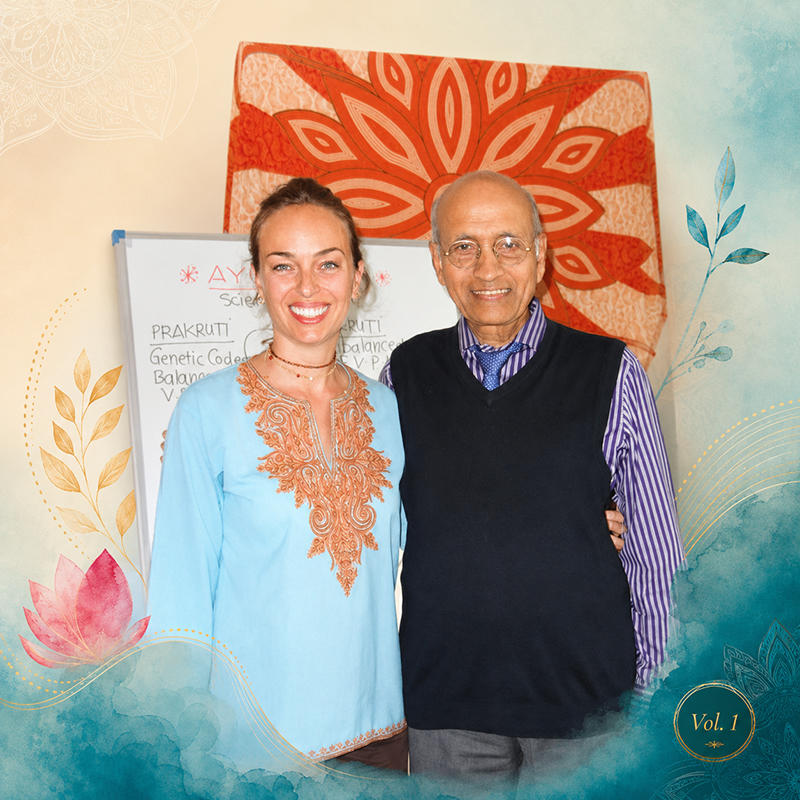
The Legendary Dr. Vasant Lad and Wellbeing Coach Ebru Şinik: An Ayurveda Interview – Vol. 1
In this rare and insightful interview, legendary Ayurvedic physician and teacher Dr. Vasant Lad shares his personal journey, his early introduction to meditation and his mission to bring Ayurvedic knowledge to the Western world.
Ebru Şinik reflects on meeting one of Ayurveda’s most respected living teachers and presents his thoughts on education, pulse assessment and the traditional relationship between Ayurveda and Jyotisha.
Meeting a Master of Ayurveda
I could hardly believe my eyes when I met Dr. Vasant Lad.
He is recognised as one of the most distinguished teachers of Ayurveda, an author whose work covers the discipline in extraordinary depth and a master in the fullest sense of the word.
For two days, I would be part of a small group of approximately twenty people receiving lessons in his presence. To me, this felt like a miracle.
I had already been fortunate enough to receive personal instruction from respected teachers in the field of Ayurveda. Meeting Dr. Lad felt like another important step on the path that was opening before me as an Ayurveda instructor.
When I look back on my life, I can say that I have met very few people whose eyes appeared to reflect such absolute love and light. Dr. Lad is one of them.
He is one of the wisest, most modest and compassionate people I have ever met. When you look into his eyes, you feel drawn into a depth in which it is almost impossible not to experience a profound sense of mercy.
Dr. Lad shares his wisdom through a powerful sense of compassion and love. I am honoured to introduce him through these pages, and I hope his reflections bring light to your life as they have to mine.
“The inspiration and energy come from that source. That is why I always say it is the speaker—it is not me; it is his blessing.”
Your Childhood Teacher Predicted That You Would Bring Ayurveda to the Western World. Could You Share That Memory?
“My guru was my father’s guru.”
Dr. Vasant Lad
My father used to wake up early every morning to practise pranayama and meditation.
When he sat cross-legged for meditation, there was absolute silence. People would whisper and walk slowly so that even their footsteps could not be heard. That was the influence of the peace created by his meditation.
One day, I asked my father what he was doing. He told me that he was practising dhyana, which means meditation.
I asked whether anyone could learn it and whether he could teach me. He replied that he was not authorised to initiate me, but that his own guru visited the town for three days at the beginning of each month.
During those visits, the guru initiated those who came to him and gave each person a mantra and a meditation practice.
I was perhaps nine or ten years old, and I eagerly waited for the first day of the following month. I continued going to school, but in one corner of my mind I was constantly waiting for the guru.
When he arrived, my father invited me to attend his discourse on the Bhagavad Gita. The room was very small and completely full. There may have been sixty people gathered inside.
I had imagined that a guru would have a long beard, matted hair, a dhoti and rudraksha prayer beads. Instead, I saw a simple older man who looked like anybody’s grandfather.
I whispered to my father, “Where is your guru?” He pointed to the ordinary-looking man and told me to wait and listen.
The guru began speaking about the Bhagavad Gita and the paths of yoga: karma, jnana and bhakti.
While speaking, he looked directly at me. It felt as though he were talking only to me. He spoke for approximately an hour and a half, and the experience completely transformed my mind.
I listened to him on the first, second and third days. Then I told him that I wanted initiation.
He whispered a mantra into my ear and placed his hand on my forehead. I felt a strong current of energy.
He told me that I would become a good student and teacher of Ayurveda, travel to England, America and Germany, write books and teach people about Ayurveda.
I was completely surprised. I told him that I did not even know English.
He replied, “You do not have to do anything. Close your eyes, say your prayers and things will happen.”
And that is what happened. I believe it was the mission of that divine teacher that I should come to the Western world, teach Ayurveda, write books and articles, and give lectures, seminars and webinars.
Cultural Note
A dhoti is a traditional garment worn by many men in India. Rudraksha seeds are traditionally used to create prayer beads within Hindu spiritual practices.
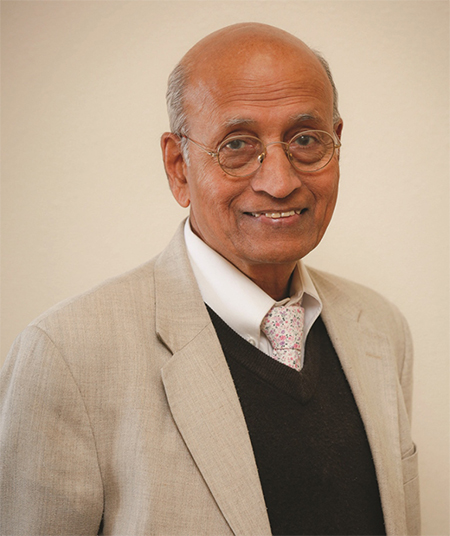
What Were the Greatest Challenges When You First Came to the United States?
“In the 1970s, a gentleman named Lenny Blank came to Pune.”
Dr. Vasant Lad
Lenny had originally come to ask about another student, who was not there. I introduced myself, offered him chai and poha, and we began talking.
We became good friends, and he began attending my lectures and observing my clinical work.
At that time, I was a professor of Ayurvedic Clinical Medicine and the Chief Medical Officer, or Medical Director, of the hospital.
Lenny told me that the knowledge of Ayurveda was important and that people in America would appreciate it.
I wondered why a country so advanced in science would welcome a system of knowledge that was thousands of years old.
He insisted that people needed this knowledge. He sent me an aeroplane ticket, and I travelled to New York, where I stayed with him in a very small apartment on East 11th Street.
I began teaching seminars there. We later travelled from New York to Chicago, Houston and New Mexico in a small white Volkswagen.
I often sat and slept in the back of the car. I watched all the seasons pass from that back seat.
In Santa Fe, we visited a natural-medicine college. I gave seminars there, and the founders invited me to stay and teach.
Although I was homesick and initially wanted to return to India, they offered to sponsor me. I began teaching regularly at the school.
After that school closed, I taught at the Institute of Traditional Medicine. In the evenings, people from the neighbourhood came for consultations.
I worked with simple herbs and spices such as cinnamon, cardamom and turmeric. Gradually, people began travelling from Albuquerque to consult with me.
Life was not easy. I missed my family, Santa Fe was very cold and the altitude was challenging. Eventually my family joined me.
When the institute where I was teaching closed, I interpreted it as a message that it was time to establish my own school.
Friends advised me to move to Albuquerque, which was warmer, more accessible and closer to the airport. This was important because I travelled almost every weekend to teach seminars and workshops.
When I first arrived in America, there were very few places to find Indian spices or food. We bought whole-wheat flour, cinnamon and cardamom from local co-operatives.
The beginning was difficult, but through grace, friendship and the support of the people around us, the Ayurvedic Institute was established in Albuquerque, New Mexico.
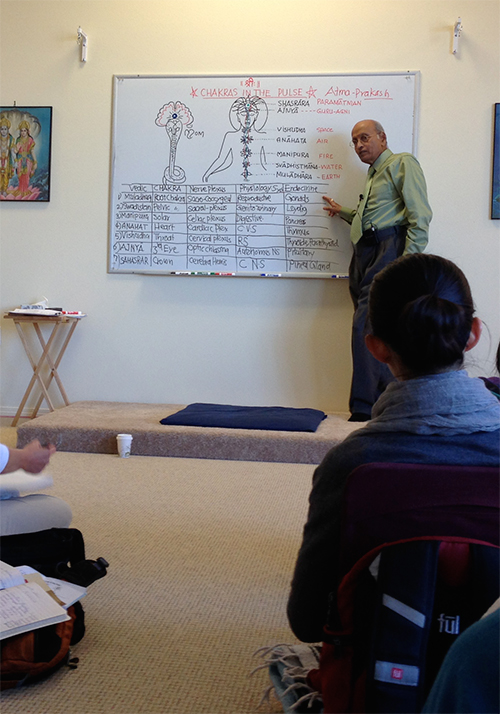
How Do You Use Pulse Assessment and Vedic Astrology During a Traditional Ayurvedic Consultation?
“I look at the pulse, the body frame, the body shape and the facial expression. These observations tell me about the person’s prakruti.”
Dr. Vasant Lad
In Dr. Lad’s traditional approach, pulse assessment, physical observation, prakruti, vikruti and a person’s birth information are considered together.
A Traditional Perspective, Not a Medical Diagnostic Method
The following section reflects Dr. Lad’s traditional interpretation of Jyotisha and Ayurveda.
Astrological charts cannot diagnose or reliably predict cancer, cardiovascular disease, stroke, diabetes, thyroid disease or another medical condition.
Medical risks, screening, diagnosis and treatment must be evaluated through appropriate clinical assessment and evidence-based healthcare.
Prakruti, Vikruti and the Birth Chart
Dr. Lad explains that he first observes the pulse, body frame, physical shape and facial expression to form a traditional Ayurvedic understanding of the person’s constitution, or prakruti.
He then considers the person’s current imbalance, known as vikruti, and compares these observations with the birth information used in Jyotisha.
Within this traditional framework, the first house of a birth chart is associated with prakruti, while other houses, planetary positions and constellations are interpreted symbolically.
Dr. Lad describes Ayurveda and Jyotisha as concurrent systems that historically developed within a shared cultural and philosophical environment.
He also explains that certain nakshatras, or lunar constellations, are traditionally associated with particular plants and herbs.
In his practice, this symbolic information may be considered alongside dosha, tissue, age, organ and pulse observations as part of a traditional interpretive system.
Four Themes That Stand Out
The Teacher–Student Relationship
Dr. Lad’s story emphasises the importance of initiation, discipline, trust and continuity within traditional learning.
Carrying Knowledge Across Cultures
His move from India to the United States illustrates both the challenges and opportunities involved in sharing a traditional system in a new culture.
Observation and Pulse Assessment
Traditional Ayurvedic consultation places great emphasis on observing constitution, current imbalance, behaviour and bodily signals.
A Holistic Worldview
Dr. Lad’s perspective reflects a traditional worldview in which the body, mind, environment, spirituality and cosmic symbolism are interconnected.
True teaching is carried not only through information, but also through presence, compassion and the example of a life devoted to learning.
Be Well, Be Happy!
Dr. Vasant Lad, Ayurveda and Jyotisha
What did Dr. Vasant Lad’s childhood guru predict?
According to Dr. Lad’s account, his guru told him that he would study and teach Ayurveda, travel abroad and write books about Ayurvedic knowledge.
How did Dr. Vasant Lad begin teaching in the United States?
He was invited to America after meeting a visitor in Pune who believed Western students would value Ayurvedic knowledge. He initially taught seminars in New York and later travelled to other parts of the country.
Why did he establish an Ayurvedic school in Albuquerque?
Albuquerque offered a warmer climate, easier access to an airport and a practical base for his regular teaching trips and seminars.
What are prakruti and vikruti?
In Ayurveda, prakruti refers to an individual’s traditional constitutional pattern, while vikruti describes the person’s current state of imbalance.
What is Jyotisha?
Jyotisha is a traditional Indian system of astrology associated with Vedic philosophy and cultural practice.
Can a birth chart diagnose or predict disease?
No. A birth chart is not a validated medical diagnostic or screening tool. Health risks and symptoms must be assessed by appropriately qualified healthcare professionals.
Can Ayurvedic assessment replace medical diagnosis?
No. Ayurvedic traditions may be explored as part of a cultural or complementary wellbeing approach, but they should not replace necessary medical screening, diagnosis or treatment.
Wellbeing Note
This interview presents personal experiences and traditional Ayurvedic and Jyotisha perspectives.
Astrology and traditional pulse interpretations do not diagnose, predict or treat cancer, cardiovascular disease, stroke, diabetes, thyroid disorders or another medical condition.
Ebru Şinik
Wellbeing Coach & Ayurveda Instructor,
Holistic Health Author